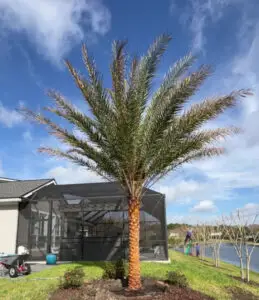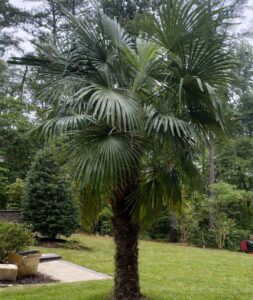

Palm trees are one of the easiest ways to give a Central Florida property that signature tropical look — but as we like to remind our customers, palms are low maintenance, not no maintenance. A little care in the right seasons is the difference between a palm that simply survives and one that stays full, green, and healthy for decades.
Central Florida sits across USDA hardiness zones 9b and 10a, which means our palms enjoy a long growing season but still face occasional winter freezes, intense summer heat, and the fast-draining sandy soils that are typical from Orlando and Kissimmee to Lakeland, Winter Park, and the surrounding communities. Each of those conditions shapes how you should water, feed, and protect your trees. This guide walks through everything you need to keep your palms thriving — and when it makes sense to call in a professional.
| Prefer to leave it to the experts? Our team offers in-person maintenance visits throughout Central Florida. Call us at 325 234 4355 to schedule a visit. |
How often should you water a newly planted palm?
The first 12 weeks after installation are the most important in your palm’s life. During this window the tree is growing new roots into the surrounding soil, and consistent moisture is critical.
- Water daily for the first 4–6 weeks after installation day.
- Then water several times per week for the following 4–6 weeks.
For field-grown trees, a good rule of thumb is 20–30 gallons per watering, though the exact amount depends on the size of the tree. There are no overwatering concerns during this initial 12-week establishment period — a properly planted palm will happily take all the water you give it.
| Planting in late fall or winter? Cut the quantity of water in half — but keep the same frequency. Cooler weather means slower water uptake, not less frequent care. |
How much water does an established palm need?
After the 12-week establishment period, a single deep watering once a week is plenty. Many palm species are drought tolerant once established and can go longer between waterings, but a consistent weekly soak is what keeps the fronds lush and green — especially through Central Florida’s dry spring months.
Watering tips that save time and water
- Water the roots, not the canopy. A palm only absorbs water through its roots, so spraying the fronds and trunk wastes both time and water.
- Apply water to the saucer directly above the rootball, where the active roots are concentrated.
- Drip irrigation is the ideal solution, but a garden hose works just fine.
- Not sure how long to run the hose? Time yourself filling a 5-gallon bucket, then multiply — four to five fills gets you into the 20–30 gallon range.
What is the best fertilizer for palm trees in Florida?
Hold off on fertilizing for the first 3 months after planting. Fresh transplants have freshly cut roots, and fertilizer applied too soon can burn them. The one exception is a product specifically formulated to support healthy transplanting.
After that, fertilizing isn’t just a nice-to-have in Central Florida — it’s important. Our sandy soils drain quickly and don’t hold nutrients well, so palms here are especially prone to potassium and magnesium deficiencies that show up as yellowing or spotted fronds. The right fertilizer prevents that and keeps the canopy a deep, healthy green.
Use a palm-specific, slow-release formula
The University of Florida (UF/IFAS) recommends a palm fertilizer with an 8-2-12 analysis plus 4% magnesium and micronutrients, with 100% of the nitrogen, potassium, and magnesium in slow-release form. (See UF/IFAS, Fertilization of Field-Grown and Landscape Palms in Florida.) This is the formulation proven to prevent the deficiencies common in Florida soils.
- Use ONLY a palm-specific fertilizer and follow the application instructions on the label.
- We recommend a slow-release granular product for more even feeding across the rootball.
- Apply roughly three times a year — a common schedule is March, June, and September.
- Avoid using regular lawn fertilizer near palms; if anything green grows within about 30 feet of the trunk, treat that zone with palm fertilizer too.
How and when should you prune palm fronds?
As a palm grows, older fronds naturally turn brown — the tree is pulling nutrients out of them to fuel new growth at the top. That’s normal, and it’s also a clue about how to prune correctly.
| The golden rule: only remove fronds that are completely brown. Any frond with green still in it is actively feeding the tree, and over-pruning is one of the most common causes of nutrient deficiency in Florida palms. |
- Always use sterilized tools to avoid spreading disease between trees.
- Many palm species have thorns or sharp leaf bases — wear protective gloves.
- Resist the urge to “hurricane cut.” Removing healthy green fronds weakens the palm and does not make it safer.
How do you protect palm trees from heat and cold in Central Florida?
Even though Orlando and most of Central Florida fall in zones 9b–10a, the region still sees several nights below freezing in a typical winter — more than enough to damage cold-sensitive palms. Summer heat and drying winds are the other end of the challenge.
Anti-transpirant application
An anti-transpirant coating can provide modest added cold protection in winter and helps minimize frond drying during the hottest summer months. The application generally lasts about two months before it needs to be reapplied, which makes July and December the two ideal times to treat your palms — December lining up neatly with Central Florida’s freeze season.
How do you maintain a diamond cut palm trunk?
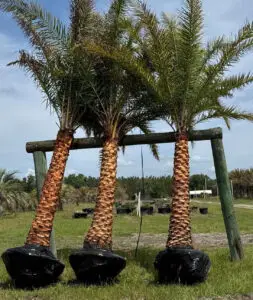
A diamond cut is a decorative trunk treatment in which the old leaf bases are trimmed into a clean, repeating diamond pattern — a popular finish on specimen palms. If your palm is diamond cut, it needs a little extra attention to keep looking its best.
- Diamond cut trunks gradually lose their color as they weather. Applying a water sealant slows that aging process and helps preserve the trunk’s original color.
- As the tree grows, you may want to continue the diamond cut on the new trunk to keep the look consistent.
When should you call a professional?
Most of this maintenance is well within reach for a homeowner who enjoys spending time in the yard. But if you’d rather not climb a ladder, you’re unsure about a struggling tree, or you simply want it handled correctly the first time, we’re here to help.
| Schedule a maintenance visit anywhere in Central Florida.Our specialists handle watering setup, fertilization, safe pruning, cold protection, and trunk care so your palms stay healthy year-round. Call 325 234 4355 or visit iguanapalms.com to book. |